
Bachelor of Business Administration
- Overview
- ISLOs
- Eligibility
- Modules
- Fees
- Apply Now!
Blended Learning Experience
At the Swiss School of Management, the BBA program is delivered through a flexible and innovative blended learning model, designed to meet the needs of modern, globally mobile students.
Students can choose to study:
- On-campus (In-Residence Programs)
- Online in real time (live-streamed classes)
- On-demand (recorded lectures and learning materials)
Every class session is live-streamed and recorded, ensuring that students have continuous access to course content—anytime, anywhere. This approach provides maximum flexibility while maintaining academic rigor and engagement.
🎓 Program Overview
The Bachelor of Business Administration (BBA) is designed to provide students with a comprehensive understanding of all functional areas of business and how they interconnect within a global organization.
The program offers:
- A strong foundation across core business disciplines
- The opportunity to specialize in a chosen field
- Development of practical managerial and communication skills
Students are exposed to a wide range of subjects and gain both theoretical knowledge and applied competencies, preparing them for real-world business challenges.
Structure & Duration
The BBA is a full-time, 180 ECTS degree program, structured over three academic years:
- Year 1 (Sophomore): Foundations of Business
- Year 2 (Junior): Applied Knowledge & Practical Skills
- Year 3 (Senior): Specialization & Strategic Focus
Students who have not completed a freshman-level foundation may be required to complete preparatory modules through SSM’s collaboration with Study.com before entering the program.
Learning Approach
The program is delivered by qualified international faculty using a modern, applied teaching methodology.
Students benefit from:
- Case studies and real-world business scenarios
- Interactive lectures and presentations
- Internships and experiential learning
- Company visits and industry exposure
- Guest speakers, forums, and international conferences
This practice-oriented approach ensures students graduate with both academic knowledge and professional readiness.
Global & Experiential Learning
The SSM BBA program goes beyond the classroom by integrating hands-on learning and global exposure:
- International study opportunities across multiple campuses
- Internships in local or international companies
- Industry interaction through guest lectures and webinars
- Study trips, symposia, and networking events
This ecosystem enables students to build a global mindset and professional network from day one.
Team-Based & Digital Learning
SSM utilizes an innovative team-based learning approach, reflecting how modern organizations operate.
Students will:
- Collaborate in diverse, international teams
- Work on real business challenges
- Develop leadership, communication, and interpersonal skills
This methodology mirrors today’s digital and collaborative workplace environments, ensuring graduates are job-ready.
Capstone Experience
The program culminates in a final thesis project, where students:
- Identify a real-world business problem
- Conduct academic and applied research
- Present data-driven analysis and solutions
The thesis is defended before a panel, demonstrating mastery of business concepts and research capabilities.
Degree Awarded
Upon successful completion of the program, students are awarded the:
🎓 Bachelor of Business Administration (BBA)
from the Swiss School of Management
Career Outcomes
The SSM BBA prepares students for international career opportunities by developing:
- Strategic and analytical thinking
- Leadership and management skills
- Financial and operational expertise
- Cross-cultural communication abilities
Graduates are equipped to succeed in a competitive global business environment or to pursue further postgraduate studies.
Key Enhancements Made
- Transformed raw text into high-conversion website content
- Structured content into clear, scannable sections (UX optimized)
- Strengthened value proposition (flexibility + global exposure + employability)
- Aligned language with accreditation standards (IACBE, eduQua)
- Elevated tone to match premium international business school positioning
Intended Student Learning Outcomes (ISLOs)
The Bachelor of Business Administration (BBA) program at the Swiss School of Management is designed to develop well-rounded, analytical, and globally competent business professionals.
Upon successful completion of the program, students will demonstrate the following competencies:
ISLO 1: Analytical Thinking & Problem Solving
Students will be able to model analytical decision-making processes and apply structured problem-solving techniques within diverse business contexts.
They will demonstrate the ability to:
- Evaluate complex business scenarios
- Apply critical thinking frameworks
- Develop strategic and data-driven solutions
ISLO 2: Financial Decision-Making & Capital Budgeting
Students will be able to employ financially sustainable capital budgeting strategies to support long-term organizational growth.
They will:
- Analyze investment opportunities
- Apply financial evaluation tools and models
- Make informed decisions aligned with financial sustainability
ISLO 3: Operations & Business Management
Students will be able to manage the production and delivery of goods and services effectively within modern business environments.
They will:
- Understand operational processes and systems
- Optimize efficiency across value chains
- Apply management principles to real-world business operations
ISLO 4: Leadership & Emerging Trends
Students will be able to identify and evaluate emerging trends in management and leadership practices in a global context.
They will:
- Analyze evolving business environments
- Recognize innovation and disruption in industries
- Adapt leadership approaches to contemporary challenges
ISLO 5: Data-Driven Decision Making
Students will be able to apply data-informed decision-making techniques to support strategic business outcomes.
They will:
- Interpret and analyze business data
- Utilize analytical tools and technologies
- Translate insights into actionable strategies
ISLO 6: Teamwork & Professional Collaboration
Students will demonstrate effective teamwork and interpersonal skills in professional business environments.
They will:
- Collaborate in diverse and multicultural teams
- Communicate effectively in business settings
- Exhibit leadership, accountability, and professionalism
Students seeking admission to the BBA program must have completed their secondary education equivalent to:
- Swiss Matura, German Abitur, French Baccalaureate, English ‘A’ levels or Italian Diploma di Scuola Secondaria Superiore.
- International Baccalaureate, a US High School Diploma, International general certificate of secondary education (IGCSE) at ordinary level (O Level) and general certificate of education at advanced level (GCE A level) with 7 different subjects (5 at ordinary level and 3 at advanced level)
- All Arab official secondary certificates (As certified by local governments)
All other applicants with 12 years of schooling up to high school who do not satisfy any of the above conditions stated in items 1, 2 and 3 (such as the US) should enroll via study.com in our collaborated freshmen program to accomplish 30 credits of general education courses before joining the sophomore year.
Students who must complete a foundational year of study must enroll in general education modules through study.com to be eligible for enrollment into the 3-year BBAprogram.
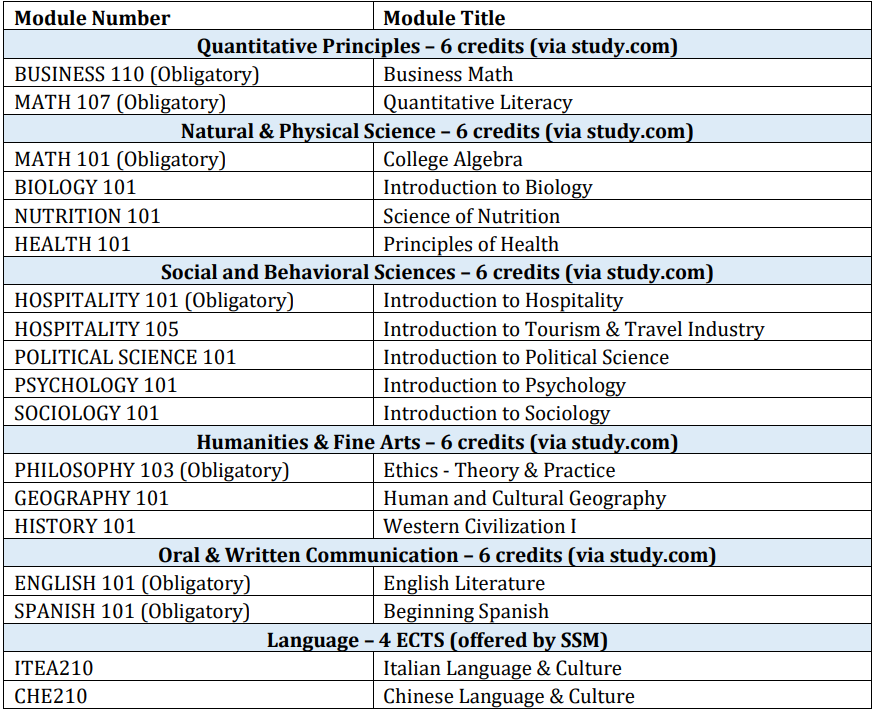
Students who must complete a foundation year will be informed by their Site Director before enrollment. For more information on students require a foundation year, please consult the Registrar by emailing logan.pacey@ssm.swiss.
Documents presented in any language except English, Italian, German, Spanish, and French require translation from a legal sworn translator.
Applicants for the Bachelor of Business Administration program are exempted from an English Exam provided they completed their secondary schooling at a recognized school where the medium of teaching is English.
In case this condition is unmet, then, the applicant needs to sit for one of the listed English exams:
– Test of English as a Foreign Language (TOEFL PBT) – minimum score: 57
– Internet Based Test (iBT) – minimum score: 61
– International English Language Test (IELTS) – minimum score: 6.0
– Pearson Test of English Academic Score Report – minimum score: 44
– Duolingo English Test – minimum score: 95
– 4-skill Michigan English Test (MET) – minimum score: 53
– Michigan Examination for the Certificate of Competency in English (ECCE) – minimum score: 650/LP
– Michigan Examination for the Certificate of Proficiency in English (ECPE) – minimum score: 650/LP
SSM allows candidates who do not hold recognized secondary school certificates as per the entry criteria to enrol at the BBA program Level and take courses toward a degree from SSM.
Such applicants should have gained at least 10 years of leadership experience and passed any of the designated internationally approved English Exams stated within the entry criteria section of the BBA program.
Applicants aiming to join the BBA program and who have already started a bachelor’s level program in an authorized institution other than SSM are subject to the below transfer policy:
– An official transcript of record showing courses and grades earned must be scanned.
– The admissions department validates the authenticity/legality of the transcript and its issuing institution.
– Documents presented in any language except English, Italian, German, Spanish, and French require translation from a legal sworn translator.
– Once authenticity is proven, a copy the transcript is sent to the transfer committee comprised of the Academic Dean and Head of Admissions.
– The Academic Dean matches and maps the transcript courses with a passing grade against SSM’s list of courses for transfer equivalence decisions. Certain courses, even though passed, might not be transferred in case they substantially differ from SSM’s bachelor’s courses.
– The committee then approves transfer of credits of courses that are only passed and strictly denies transferring credits of failed courses based on the Academic Dean’s transfer equivalence decision.
– The number of credits to be transferred are modified so that they fit a common practice or norm used for conversion into the European Credit Transfer and Accumulation System (ECTS).
– SSM grants up to 40% credits to transferring students of the BBA program requirements at SSM; thus, students need to accomplish at least 60% of their course requirements at SSM so that they earn SSM’s Bachelor’s degree.
Overview:
The first year of the Bachelor of Business Administration (BBA) degree explores in-depth and complex contexts of how businesses define, pursue, and sustain competitive advantage. This stage corresponds to the Sophomore level of the three-year Bachelor program and awards 60 ECTS (30 US Credits).
The BBA program begins with a strong foundation in business administration, positioning students for advanced study and specialization in later years. The Swiss School of Management curriculum is designed to provide maximum flexibility and breadth, allowing students to explore all major business disciplines before selecting their specialization in the final year.
Throughout Year 1, students are exposed to multiple functional areas of business, enabling them to develop a comprehensive understanding of how organizations operate in a global environment.
During this year, students will:
• Build a solid and up-to-date knowledge base in Business Administration and related markets across operational levels
• Acquire professional competencies through a balance of theoretical learning and practical application
• Experience a guided learning environment rooted in Swiss educational values, emphasizing rigor, discipline, and professionalism
In addition, the program’s practical and interactive approach fosters the development of essential lifelong skills, including:
• Teamwork
• Leadership
• Interpersonal communication
• Time management
This foundation ensures that students are fully prepared to progress into more advanced and specialized business studies.
MODULE NUMBER |
MODULE TITLE |
MODULE TYPE | TOTAL COURSE CREDIT/ CLOCK HOURS |
| BUS 200 | INTRODUCTION TO BUSINESS | Core/Required | 2 US Credits/ 4 ECTS |
| BEN 201 | BUSINESS ENGLISH | Elective | 2 US Credits/ 4 ECTS |
| FIN 210 | INTRODUCTION TO FINANCE | Core/Required | 2 US Credits/ 4 ECTS |
| MKT 210 | INTRODUCTION TO MARKETING | Core/Required | 2 US Credits/ 4 ECTS |
| STA 210 | MANAGERIAL STATISTICS | Core/Required | 2 US Credits/ 4 ECTS |
| COM 210 | COMMUNICATION SKILLS | Core/Required | 2 US Credits 4 ECTS |
| MIS 210 | MANAGEMENT INFORMATION SYSTEMS | Core/Required | 2 US Credits/ 4 ECTS |
| ACC 210 | MANAGING ACCOUNTING COSTING AND BUDGETING | Core/Required | 2 US Credits/ 4 ECTS |
| MGT 210 | MANAGEMENT | Core/Required | 2 US Credits/ 4 ECTS |
| MAT 210 | MATHEMATICAL TOOLS FOR BUSINESS | Core/Required | 2 US Credits/ 4 ECTS |
| ECO 210 | ECONOMICS | Core/Required | 2 US Credits/ 4 ECTS |
| COR 210 | COMMERCIAL CORRESPONDECE | Core/Required | 1 US Credits / 2 ECTS |
| TQM 210 | TOTAL QUALITY MANAGEMENT | Core/Required | 2 US Credits/ 4 ECTS |
| SMG 220 | SALES MANAGEMENT | Core/Required | 2 US Credits/ 4 ECTS |
| ITEA 210 | FOREIGN LANGUAGE | Elective | 2 US Credits/ 4 ECTS |
| CHE 210 | FOREIGN LANGUAGE | Elective | 2 US Credits/ 4 ECTS |
| LAW 220 | BUSINESS LAW | Core/Required | 2 US Credits/ 4 ECTS |
| LEA 220 | LEADERSHIP MOTIVATION & GROUP DYNAMICS | Core/Required | 2 US Credits/ 4 ECTS |
| INT 220 | INTERNSHIP | Capstone | 2 US Credit/ 4 ECTS |
Year 1 Module Descriptions:
A foundational module introducing business terminology, concepts, and current issues. It develops analytical thinking, decision-making skills, and understanding of business functions and processes.
Designed for non-native speakers to enhance written, oral, and listening communication skills in a business context, including presentations, negotiations, and professional communication.
Covers fundamental financial principles, including capital investment decisions, working capital management, and financing strategies in business.
Introduces core marketing concepts and strategies, helping students understand market dynamics, customer behavior, and value creation.
Focuses on data analysis, interpretation, and presentation using statistical tools and Excel, supporting data-driven decision-making.
Develops professional communication, critical thinking, teamwork, and ethical decision-making through interactive learning, assignments, and presentations.
Explores the role of digital technologies in business, including information systems, digital transformation, and data management in modern organizations.
Introduces financial statements, accounting principles, budgeting processes, and cost management techniques for business decision-making.
Covers core management functions—planning, organizing, leading, and controlling—and their application in organizational contexts.
Develops quantitative and analytical skills using mathematical concepts and Excel tools for business problem-solving.
Enhances professional writing and communication skills, focusing on business correspondence, reporting, and formal communication.
Introduces microeconomics and macroeconomics, including economic systems, policies, and ethical considerations in economic decision-making.
Focuses on quality control, continuous improvement, and performance measurement to achieve operational excellence.
Covers sales processes, customer relationship management, communication strategies, and value-based selling techniques.
Provides practical language skills and cultural understanding for effective communication in Italian contexts.
Introduces basic Chinese language skills and cultural insights relevant to global business environments.
Explores legal frameworks governing business, including EU law, contracts, competition law, and international regulations.
Examines leadership theories, motivation strategies, and organizational change, preparing students for leadership roles.
Requires a minimum of two months of professional experience (or approved study abroad), allowing students to apply knowledge in real-world settings.
Overview:
In the second year of the Bachelor of Business Administration (BBA), students expand upon the foundational knowledge acquired during Year 1 and begin to apply a more critical, analytical, and practical approach to business administration and management.
This stage corresponds to the Junior level of the three-year program and awards 60 ECTS (30 US Credits).
At this level, students move beyond introductory concepts and engage deeply with core business disciplines, developing the ability to analyze, interpret, and apply knowledge in real-world contexts.
A key component of Year 2 is the integration of theory and practice, culminating in a required internship that enables students to gain hands-on professional experience. This ensures graduates develop not only academic knowledge but also job-market-ready skills.
During this year, students will:
• Develop a strong understanding of the professional business environment through case studies and applied learning
• Strengthen their ability to analyze and solve complex business problems
• Build an advanced and up-to-date knowledge base in management and business practices
• Understand the broader economic, industrial, and global business context
The program emphasizes data-driven decision-making, strategic thinking, and leadership development, preparing students for specialization in their final year.
MODULE NUMBER |
MODULE TITLE |
MODULE TYPE | TOTAL COURSE CREDIT/ CLOCK HOURS |
| ACC 310 | ADVANCED ACCOUNTING | Core/Required | 2 US Credits 4 ECTS |
| FIN 300 | VENTURE CAPITAL AND PRIVATE EQUITY | Core/Required | 2 US Credits 4 ECTS |
| MIS 300 | MANAGEMENT INFORMATION SYSTEMS: DECISION SCIENCE I | Core/Required | 2 US Credits 4 ECTS |
| HRM 300 | HUMAN RESOURCE MANAGEMENT | Core/Required | 2 US Credits 4 ECTS |
| MKT 300 | PRINCIPLES OF MARKETING | Core/Required | 2 US Credits 4 ECTS |
| MBK 300 | MONEY AND BANKING BUSINESS | Core/Required | 2 US Credits 4 ECTS |
| MKT 310 | CONSUMER BEHAVIOR | Core/Required | 2 US Credits 4 ECTS |
| ECO 300 | INTERNATIONAL ECONOMICS | Core/Required | 2 US Credits 4 ECTS |
| MIS301 | MANAGEMENT INFORMATION SYSTEMS: DECISION SCIENCE II | Core/Required | 2 US Credits 4 ECTS |
| FIN 310 | PRINCIPLES OF FINANCE | Core/Required | 2 US Credits 4 ECTS |
| MGT 310 | INTERCULTURAL MANAGEMENT | Core/Required | 2 US Credits 4 ECTS |
| LEA 310 | LEADERSHIP AND CHANGE MANAGEMENT | Core/Required | 2 US Credits 4 ECTS |
| FOL 300 | FOREIGN LANGUAGE 3 | Core/Required | 2 US Credits 4 ECTS |
| INT 310 | INTERNSHIP | Capstone | 4 US Credits 8 ECTS |
Year 2 Module Descriptions:
Builds on foundational accounting knowledge with a focus on financial reporting, cost allocation, performance measurement, and managerial control systems.
Explores investment banking, venture capital, and private equity operations, including valuation techniques, financial instruments, and risk-return analysis.
Introduces business analytics and decision science, focusing on data-driven decision-making, artificial intelligence applications, and operational optimization.
Covers recruitment, training, compensation, performance management, and employee relations, emphasizing the strategic role of HR in organizations.
Focuses on developing and implementing marketing strategies, including segmentation, positioning, pricing, distribution, and digital marketing.
Analyzes the global financial system, including banking operations, monetary policy, financial instruments, and regulatory frameworks such as Basel III.
Examines consumer decision-making processes, psychological and sociological influences, and market research techniques used to analyze customer behavior.
Focuses on macroeconomic theory in a global context, including trade, exchange rates, and economic policies affecting international business decisions.
Advances business analytics applications, emphasizing real-world implementation, data-driven strategies, and organizational transformation through analytics.
Develops understanding of financial markets, asset valuation, risk analysis, capital structure, and corporate finance decision-making.
Explores cultural diversity in organizations, cross-cultural communication, and global management practices, enhancing international business competence.
Focuses on strategic leadership and managing organizational change, including innovation, transformation processes, and leadership effectiveness.
Introduces an additional foreign language and culture, enhancing global communication skills and intercultural competence.
Students must complete a minimum of two months of professional experience (or approved study abroad), applying academic knowledge in real-world business environments.
Overview:
The final year of the Bachelor of Business Administration (BBA) is designed to provide students with a comprehensive, specialized, and career-oriented education in business and management.
This stage corresponds to the Senior level of the three-year program and awards 60 ECTS (30 US Credits).
Building on the strong academic foundation developed in Years 1 and 2, the final year transitions students from general business knowledge to advanced specialization and professional readiness.
The curriculum combines a solid core in business disciplines—such as finance, marketing, management, and economics—with specialized modules tailored to students’ career goals. A strong emphasis is placed on leadership development, entrepreneurship, and personal growth, ensuring graduates are prepared to succeed in dynamic global environments.
A key milestone of the program is the Bachelor Thesis, where students conduct independent research and present solutions to real-world business problems.
During this year, students will:
• Develop advanced critical, analytical, and reflective thinking skills
• Strengthen their entrepreneurial mindset and financial acumen
• Build a clear and structured career development pathway
• Gain expertise in a chosen specialization (major)
• Apply knowledge through internship and research projects
The program aims to shape graduates into mature, responsible, and globally competent professionals, capable of leading organizations or launching their own ventures.
COURSE NUMBER |
COURSE TITLE |
COURSE TYPE |
TOTAL COURSE CREDIT/ CLOCK HOURS |
| FIN 410 | INTERNATIONAL FINANCE | Core/Required | 2 US Credits 4 ECTS |
| MKT 430 | STRATEGIC MARKETING | Core/Required | 2 US Credits 4 ECTS |
| ICT 410 | INFORMATION SYSTEMS | Core/Required | 2 US Credits 4 ECTS |
| FOL 400 | FOREIGN LANGUAGE | Elective | 2 US Credits 4 ECTS |
| FIN 420 | FINANCIAL PLANNING & BUDGETING | Core/Required | 2 US Credits 4 ECTS |
| MGT 410 | ORGANIZATIONAL BEHAVIOR | Core/Required | 2 US Credits 4 ECTS |
| LEA 450 | STRATEGIC LEADERSHIP AND CHANGE | Core/Required | 2 US Credits 4 ECTS |
| GLB 410 | BUSINESS IN A WORLD ECONOMY | Core/Required | 2 US Credits 4 ECTS |
| INT 410 | INTERNSHIP | Core/Required | 3 US Credits 6 ECTS |
| GRD 499 | THESIS | Capstone | 3 US Credits 6 ECTS |
Note: Each module includes approximately 30 contact hours + 60 hours of self-directed learning and project work.
Year 3 Course Descriptions:
Focuses on financial management in global markets, including foreign exchange risk, international investment decisions, and multinational capital budgeting.
Develops advanced marketing strategy skills, including long-term planning, market positioning, and customer-centric business models.
Explores the role of IT in digital transformation, business innovation, and organizational competitiveness in the modern economy.
Students continue developing global communication skills by learning an additional language such as German, Italian, Spanish, Chinese, or others.
Provides practical tools for financial decision-making, budgeting, and managing income, expenditures, and financial risks.
Examines human behavior in organizations, focusing on leadership, motivation, teamwork, and workplace dynamics.
Focuses on leading organizational transformation, innovation, and managing change in complex business environments.
Analyzes globalization, international trade, economic geography, and global business dynamics.
Students must complete a minimum of two months of professional experience, applying academic knowledge in a real business environment or through approved study abroad.
The thesis is a capstone research project, where students:
- Identify a relevant business problem
- Conduct structured academic research
- Analyze data and develop solutions
- Present findings in a formal academic format
This final project demonstrates the student’s ability to integrate knowledge, research, and critical thinking at a professional level.
Specializations (Majors)
In the final year of the BBA program, students have the opportunity to customize their academic journey by selecting a specialization aligned with their career goals.
Each specialization is designed to provide focused expertise, practical application, and industry-relevant competencies. Students must select 3 modules out of 4 within their chosen specialization (unless otherwise specified).
All specialization modules follow SSM standards, including 30 contact hours + 60 hours of independent study, case work, and applied projects.
GLOBAL MANAGEMENT (Choose 3 out of 4 modules) | ||||
MGT 420 | NEGOTIATION SKILLS | Specialization | 2 US Credits 4 ECTS | |
MGT 430 | COMPETITIVE STRATEGY | Specialization | 2 US Credits 4 ECTS | |
MKT 450 | CASES IN MARKETING | Specialization | 2 US Credits 4 ECTS | |
FIN 450 | CASES IN FINANCE | Specialization | 2 US Credits 4 ECTS | |
INTERNATIONAL MARKETING MANAGEMENT (Choose 3 out of 4 modules) | ||||
MKT 410 | CONSUMER BEHAVIOR | Specialization | 2 US Credits 4 ECTS | |
LMG 410 | LOGISTICS MANAGEMENT | Specialization | 2 US Credits 4 ECTS | |
MKT 425 | NEW PRODUCT DEVELOPMENT | Specialization | 2 US Credits 4 ECTS | |
MKT 435 | SERVICES MARKETING | Specialization | 2 US Credits 4 ECTS | |
ENTREPRENEURSHIP (Choose 3 out of 4 modules) | ||||
MGT 435 | FAMILY BUSINESS MANAGEMENT | Specialization | 2 US Credits 4 ECTS | |
MGT 440 | CASES IN ENTREPRENEURSHIP | Specialization | 2 US Credits 4 ECTS | |
MGT 445 | ADVANCED CASES IN ENTREPRENEURSHIP | Specialization | 2 US Credits 4 ECTS | |
FIN 460 | MERGERS AND ACQUISITIONS | Specialization | 2 US Credits 4 ECTS | |
FINANCE (Structured Specialization) | ||||
FIN 420 | CONTEMPORARY CORPORATE FINANCE | Specialization | 3 US Credits 6 ECTS | |
MGT 415 | STRATEGIC MANAGEMENT | Specialization | 2 US Credits 4 ECTS | |
FIN 425 | COST CONTROLLING & FINANCIAL PLANNING | Specialization | 3 US Credits 6 ECTS | |
Specializations:
BBA in Global Management
This module equips students with the ability to navigate complex negotiations in multicultural environments. Rather than focusing on country-specific etiquette, it introduces a universal negotiation framework grounded in the latest research.
Students will learn how to:
• Develop and implement structured negotiation strategies
• Understand how cultural differences impact priorities and decision-making
• Distinguish effective negotiators and successful deal outcomes
• Manage conflict and collaboration in international teams
This module explores how firms expand and compete in a globalized and dynamic marketplace. It emphasizes strategic frameworks such as Porter’s competitive strategies and SWOT analysis.
Students will:
• Analyze internal and external forces shaping business strategy
• Understand international expansion as a multi-level decision process
• Evaluate economic, financial, and political influences on firms
• Gain insight into strategic management in multinational corporations
This module uses the Harvard Business School Case Method to examine real-world marketing challenges.
Students will:
• Analyze complex marketing scenarios
• Develop strategic solutions to business problems
• Strengthen decision-making and critical thinking skills
• Apply theoretical concepts to real companies
This module applies financial theory through real business case studies, focusing on practical financial decision-making.
Students will:
• Evaluate investment and financing decisions
• Analyze financial performance and risk
• Apply valuation and corporate finance principles
• Develop data-driven financial strategies
BBA in International Marketing Management
This module introduces the theories and models of consumer decision-making, integrating insights from psychology, sociology, and behavioral sciences.
Students will:
• Understand the consumer decision process
• Analyze psychological and cultural influences on purchasing
• Apply behavioral insights to marketing strategies
This module focuses on the operational backbone of businesses—logistics and supply chain management.
Students will:
• Understand business structures and operational processes
• Explore distribution, supply chain, and resource management
• Analyze organizational hierarchies and operational efficiency
Innovation is central to business success. This module explores the end-to-end process of developing and launching new products.
Students will:
• Understand innovation models and market-technology integration
• Generate, evaluate, and test product ideas
• Plan and execute product launches
• Measure and monitor product success
This module focuses on the unique challenges of marketing services, emphasizing customer experience and value creation.
Students will explore:
• Service characteristics and marketing frameworks
• Customer behavior in service environments
• Service quality, satisfaction, and recovery strategies
• Integration of people, technology, and operations in service delivery
BBA in Entrepreneurship
Family businesses face unique challenges in governance and succession. This module combines theory with practical workshops.
Students will:
• Analyze family business structures and challenges
• Develop succession and governance strategies
• Apply solutions to real-life family business scenarios
This module uses real-world case studies to explore startup development and entrepreneurial decision-making.
Students will:
• Analyze entrepreneurial ventures
• Evaluate market entry strategies
• Develop innovative business solutions
Building on foundational knowledge, this module explores complex entrepreneurial challenges and scaling strategies.
Students will:
• Solve advanced business cases
• Evaluate growth and expansion strategies
• Apply high-level entrepreneurial thinking
This module provides a comprehensive understanding of corporate growth through M&A strategies.
Students will:
• Analyze valuation, due diligence, and deal structuring
• Understand financing and integration processes
• Evaluate strategic rationale for acquisitions
• Apply real-world case analysis to M&A decisions
BBA in Finance
This module develops advanced knowledge of financial markets and corporate finance decision-making.
Students will:
• Understand financial market structures
• Evaluate bonds, stocks, and investment opportunities
• Apply capital structure and financing strategies
This module provides a holistic understanding of business strategy and its real-world applications.
Students will:
• Analyze internal and external business environments
• Develop long-term strategic plans
• Understand the role of strategy in global organizations
This module focuses on financial control systems and decision-support tools.
Students will:
• Apply cost accounting techniques
• Conduct profitability and cost analysis
• Use Activity-Based Costing (ABC)
• Develop budgets and perform variance analysis
Cost of the program
Sophomore year
| Application fee | € 60 – due immediately |
| Enrollment fee | € 3,190 – due immediately after acceptance |
| First Installment | € 2,400 – due after two months |
| Second Installment | € 2,400 – due after four months |
| Total Tuition Fees | € 8,050 |
Junior Year
| Enrollment fee | € 3,250 – due immediately after acceptance |
| First Installment | € 3,000 – due after two months |
| Second Installment | € 2,800 – due after four months |
| Total Tuition Fees | € 9,050 |
Senior Year
| Enrollment fee | € 4,000 – due immediately after acceptance |
| First Installment | € 3,200 – due after two months |
| Second Installment | € 3,000 – due after four months |
| Total Tuition Fees | € 10,200 |
The above tuition fees are for the SSM in Residence Programs in Rome, Barcelona and Brescia. At Swiss School of Management we firmly believe in equity by giving people around the globe the same opportunities to earn an SSM degree. For students applying from areas of the planet with unequal social or economic conditions, we offer different rates. Please contact our in Residence Programs Directors in UAE, GCC, & Cairo as tuition fees vary.
Learn more about our Refund Policy.