
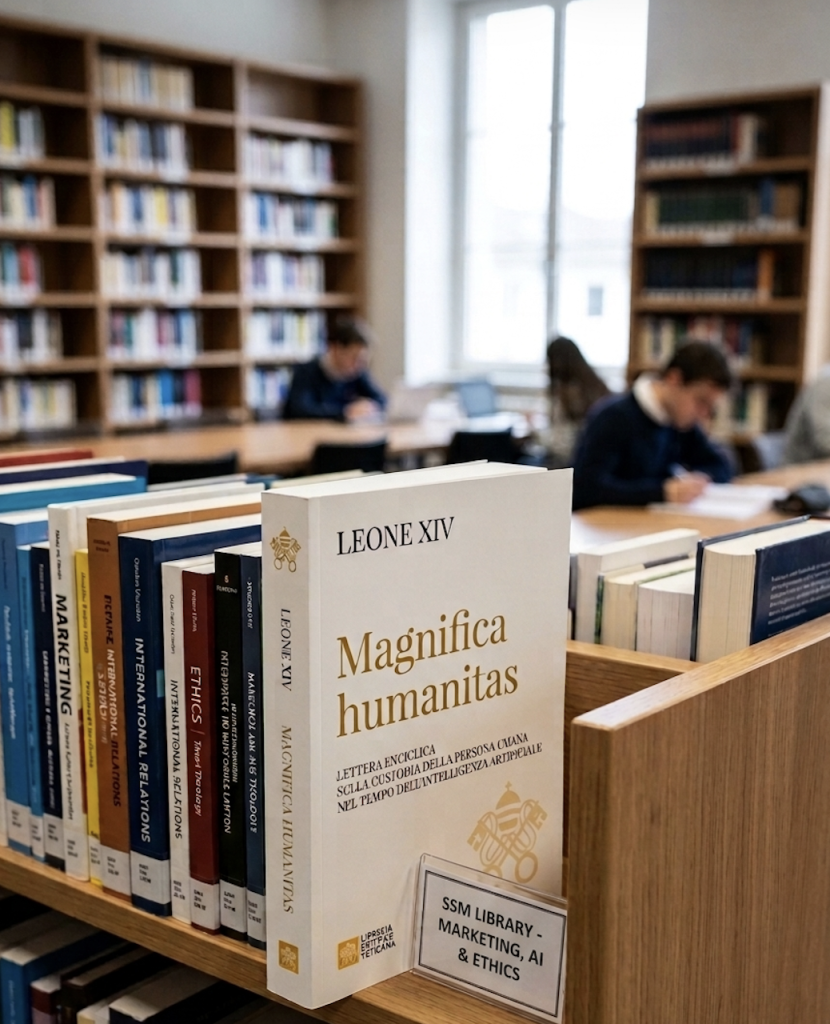
AI Ethics in the Reflections on Pope Leo XIV’s “Magnifica Humanitas”
In SSM Global’s marketing classes, we have been studying innovative new digital technologies for several years now, with a particular focus on AI, both generative, analytical and predictive, and their impact on various sectors of our professional and academic lives.
Students arrive in class already having some experience with Generative AI, such as ChatGPT, although in our programs they love discovering the history of AI, its progress, and its limits, experimenting together with its use to conduct research, verify reliable sources, and critically analyze prompts.
Thus, in May, coinciding with the publication of Magnifica Humanitas, the encyclical letter of Pope Leo XIV dedicated specifically to AI, we decided not to ignore this reading and to look at it together to observe how the discussion is evolving around this topic, which is now well beyond the technological, economic, and financial spheres, but deeply enters into society, psychology, and people’s spirituality, expanding to the maximum the Ethical Dilemma that involves this technology.
In this regard, we share the interesting analysis and perspective of Grace Tilahun, a third-year international student of the BBA Strategic Marketing program at our SSM Rome campus, who has just brilliantly concluded her studies. Grace, who has always been passionate about innovation, sustainability, branding, and artificial intelligence, aims to build an international career in entrepreneurship and offers us a valuable summary of this historic document.
The focus of Magnifica Humanitas: technology at the service of Humanity
Magnifica Humanitas is Pope Leo XIV’s first ever encyclical, having the primary focus upon social, ethical as well as human implications of Artificial Intelligence. The specific document clearly argues that the technology should be potentially served as humanity rather than to dominate it, necessarily emphasizing upon social justice, human dignity, truth, solidarity as well as common good (Encyclical Letter of His Holiness Leo XIV Magnifica Humanitas, 2026).
The Pope significantly warns against the concrete risks of our time:
- An excessive concentration of technological power.
- Digital exclusion and algorithmic bias.
- Unemployment caused by automation.
- The utilization of AI in warfare.
While clearly recognizing the benefits of AI, the entire encyclical stresses that responsibility, human values, and moral judgment should remain centralized within technological development.
In my view, the encyclical puts forward an important ethical framework meant for discussing Al as well as strongly promotes human rights, inclusion along with respect for all the vulnerable groups (Huang et al., 2022). However, it is primarily rooted right into the Catholic social teaching. Although it invites the dialogue with all the people and necessarily addresses all kinds of universal concerns, the same might not entirely encompass with all the non-Christian traditions as well as the indigenous viewpoints that could wholly strengthen its aspect of global inclusiveness.
(Grace Abera Tilahun)
I totally believe that SSM Global in an active manner helps the students in correct understanding of this text along with its implications. All the future leaders will entirely face decisions that involves ethics, Al governance, privacy, employment as well as social responsibility. Studying Magnifica Humanitas can offer encouragement to critical thinking regarding technology as well as the human values (Galiana, Gudino & González, 2024).
The educational discussions upon the encyclical would provide help to the students to potentially evaluate both the opportunities as well as the risks of Al while effectively developing a set of responsible leadership skills meant for the rapidly changing world. Also, the encyclical encourages enhanced accountability among all the busiensses, governments and the educational institutions. Its direct emphasis upon the ethical innovation clearly highlights the associated importance of effectively ensuring that the relevant technological progress entirely benefits the society, as a whole.
Why discuss this topic at a Business School like SSM? A critical and global perspective
From our student’s point of view, the encyclical puts forward an important ethical framework for discussing AI and strongly promotes human rights, inclusion, and respect for all vulnerable groups. However, as it is primarily rooted right into Catholic social teaching, Grace raises a stimulating reflection: although the Pope invites dialogue with all people and addresses universal concerns, the text might not entirely encompass non-Christian traditions or indigenous viewpoints, elements that could have wholly strengthened its aspect of global inclusiveness.
The role of SSM Global is actively to help students gain a correct understanding of this text along with its implications. All future leaders will entirely face decisions that involve ethics, AI governance, privacy, employment, as well as social responsibility.
As teacher, I believe that studying Magnifica Humanitas offers encouragement for critical thinking regarding technology and human values. In my perspective, educational discussions on the encyclical help students effectively evaluate both the opportunities and the risks of AI while developing a set of responsible leadership skills meant for a rapidly changing world. Technological progress is only truly valuable if its direct emphasis on ethical innovation highlights the importance of ensuring that it benefits society as a whole.
About the co- author
Grace Abera Tilahun is a final-year international business student who is just completing her BBA at Swiss School of Management Rome. With a strong inclination toward strategic marketing, ethical innovation, and global markets, Grace perfectly embodies the spirit of the future leaders that SSM is committed to training.
Reference:
Encyclical Letter of His Holiness Leo XIV Magnifica Humanitas (15 May 2026). (2026). Vatican.va.
[Image created with AI]